Event communications often bring together many small but important details. A consistent approach to formatting helps audiences find what they need quickly and creates a more cohesive experience before, during, and after an event.
Event style guide cheat sheet
Use this cheat sheet to apply consistent editorial style and formatting to common event details across promotional materials, including invitations, signage, and programs.
Dates | ||
|---|---|---|
| Standard dates | Abbreviate Jan., Feb., Aug., Sept., Oct., Nov., and Dec. when used with a specific date. Always spell out March, April, May, June, and July. | Thursday, Oct. 15, 2026 Thursday, March 4, 2027 |
| Formal dates | Spell out the month for formal invitations or ceremonial events. Do not add st, nd, rd, or th to the date. | Monday, February 19, 2027 February 19, not February 19th |
| Date ranges | Use an en dash without spaces. Repeat the month or year when the range crosses into a new month or year. When using from, pair it with to. | Sept. 18–20, 2026 Sept. 28–Oct. 12, 2026 from Aug. 8 to 18 |
Times | ||
|---|---|---|
| Standard times | Drop :00 when the time falls on the hour. Use lowercase a.m. and p.m. with periods. Use noon and midnight. | 7 p.m. 4:30 p.m. noon |
| Time ranges | Use an en dash without spaces. Repeat a.m. or p.m. only when the designation changes. | 3–6 p.m. 10 a.m.–2 p.m. |
| Date and time together | Use at when the date and time appear on one line or in a sentence. | Thursday, Oct. 15, 2026, at 7 p.m. |
Location | ||
|---|---|---|
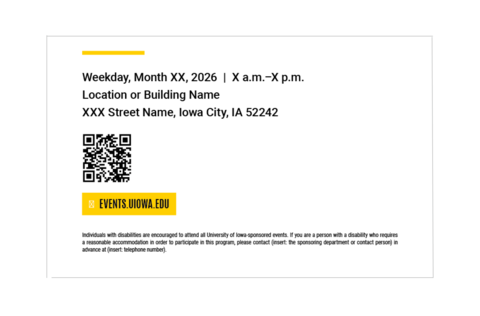
| Room and building | List the most specific location first, followed by the building. | Concert Hall, Voxman Music Building Room 245, University Capitol Centre |
Links and QR codes | ||
|---|---|---|
| Links | Pair the URL with clear action language. Whenever possible, use a short, memorable redirect instead of a long web address. Use a colon after a short label. Use at when the URL appears in a sentence. | Register: events.uiowa.edu/author-series Register at events.uiowa.edu/author-series. |
| QR codes | Include a readable URL near each QR code. Both should lead to the same place. |
|
Presenting event information
The exact content may vary, but essential details should remain immediately recognizable.
Sample hierarchy
FALL AUTHOR SERIES
An evening with Jane Smith, author of Riverbend
Thursday, Oct. 15, 2026, at 7 p.m.
Shambaugh Auditorium, Main Library
Free with registration
Register: events.uiowa.edu/author-series
For additional guidance on editorial style, including grammar, punctuation, capitalization, and usage, refer to the University of Iowa Editorial Style Guide.
Accessibility information
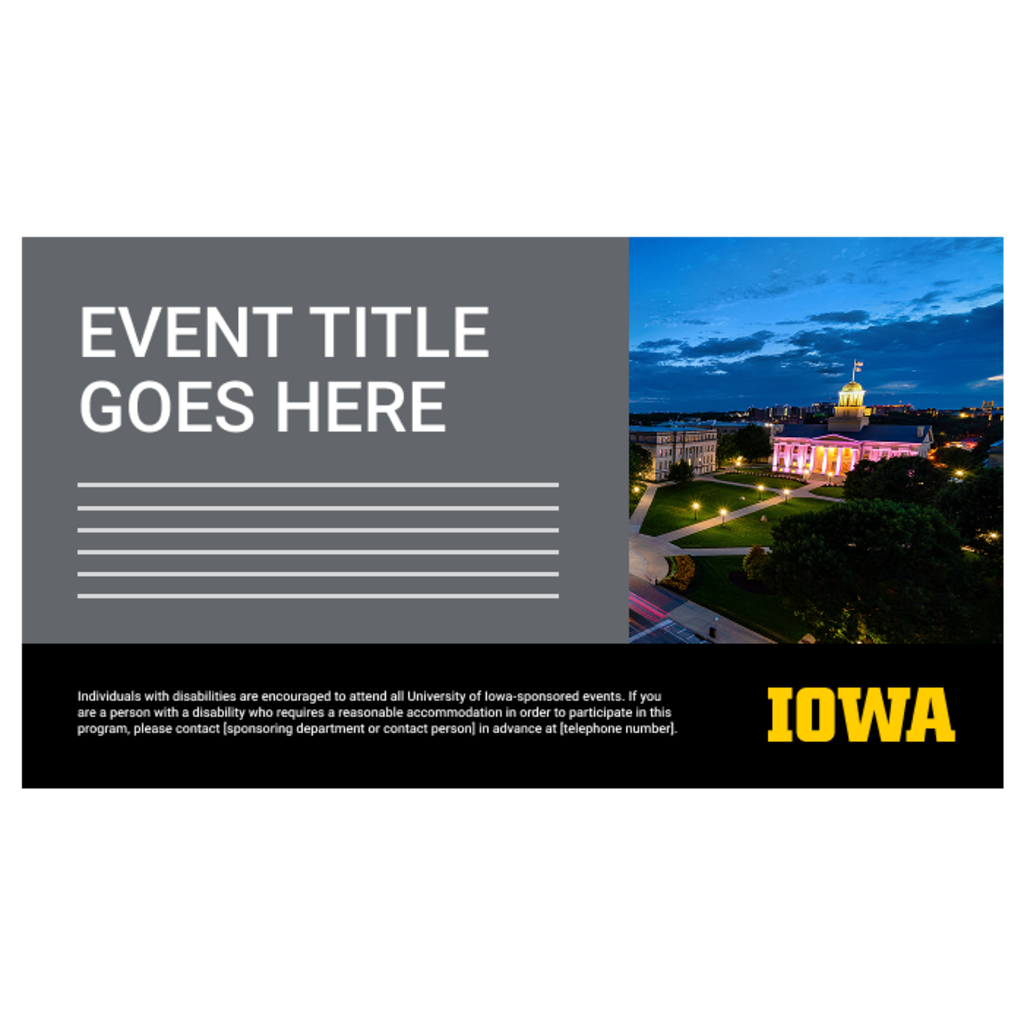
Include the university accessibility statement on communications promoting a University of Iowa-sponsored event. Replace the bracketed information with a real sponsoring department or contact person and phone number. Keep the statement readable, with sufficient size and contrast.
Individuals with disabilities are encouraged to attend all University of Iowa-sponsored events. If you are a person with a disability who requires a reasonable accommodation in order to participate in this program, please contact [sponsoring department or contact person] in advance at [telephone number].
Branding requirements
University identification
Use the required IOWA logo or an appropriate unit lockup to identify the University of Iowa. The university name does not need to be repeated in the event copy when the logo or lockup already provides that context.
Internal cosponsorship
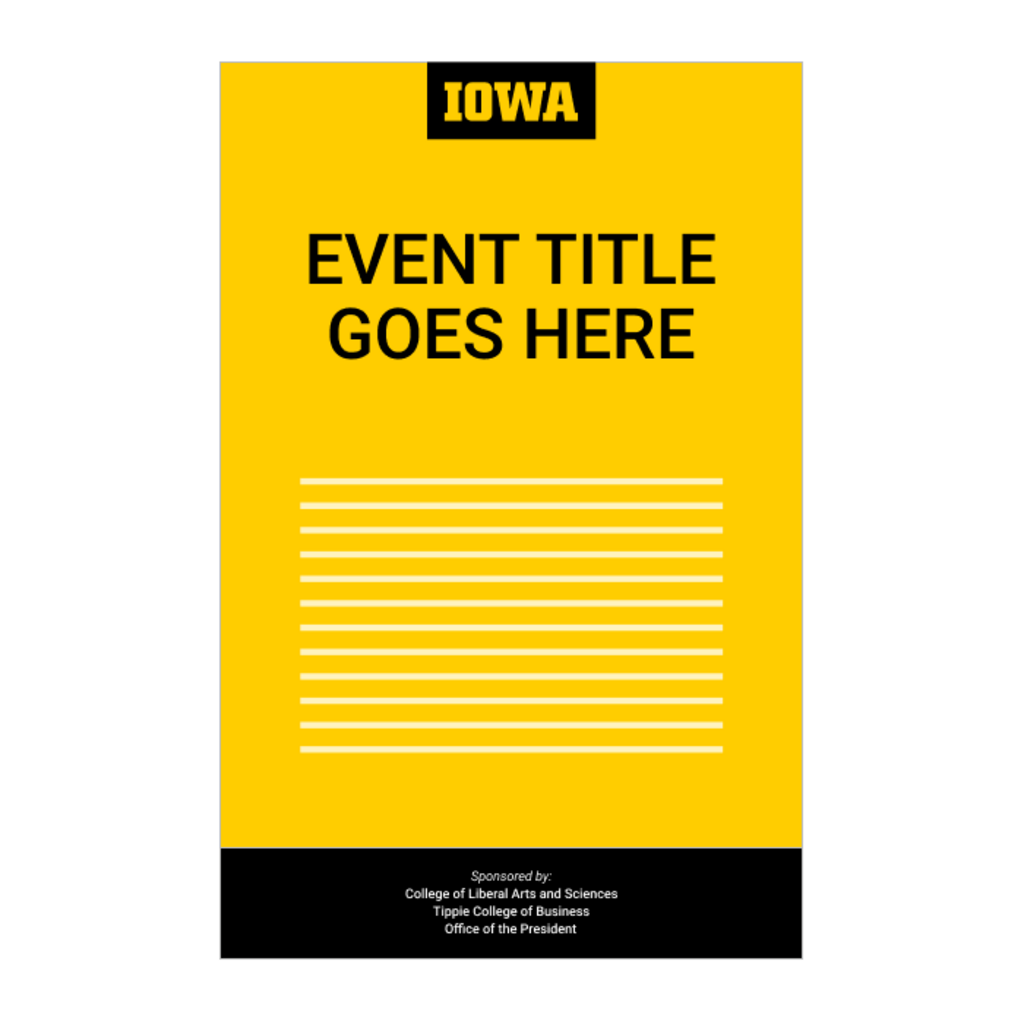
When multiple campus units partner together, use the block IOWA logo and list unit names separately in plain text. Use type style (size, color, weight, etc.) to denote different levels of sponsorship if necessary. Don’t use multiple lockups.